

A Victorian sole practitioner advertised herself as a "Criminal Defence Specialist" with a "team of lawyers". She had no specialist accreditation and no employees. The tribunal reprimanded and fined her, and ordered extra ethics training (Proctor, 2022).
Family law firms play by the same rules. With 16,188 practising solicitors in Queensland (Legal Services Commission, 2025), it's tempting to push the wording to stand out. Is it worth the risk?
This guide sets out what a Queensland family law firm's website, reviews, ads and social posts can and can't say. The checklist comes first, so you can audit your own marketing today. It's general marketing information, not legal advice.
Key takeaways
- Rule 36 is the starting point. All advertising, marketing and promotion must not be false, misleading or deceptive, offensive, or prohibited by law (Australian Solicitors' Conduct Rules 2023, rule 36.1).
- Don't call yourself a family law specialist unless you're accredited. The Legal Services Commission's view is that "specialist" is likely a derivative of "accredited specialist". Only 3.5% of Queensland solicitors held QLS accreditation in late 2023 (Proctor, 2023).
- Reviews must be genuine and unfiltered. The Queensland Law Society warns that asking only happy clients may be problematic, and the ACCC says removing genuine negative reviews can mislead.
- Client stories need consent and anonymity. Get written consent, de-identify comments, and never identify the parties to family law proceedings.
- Show the total price. If you quote a fee, the ACCC requires the total as a single figure, at least as prominent as any part price.
- Google Ads won't check the law for you. Google's policy expects advertisers to research the local rules for every location they target.
The family law advertising checklist: 9 checks
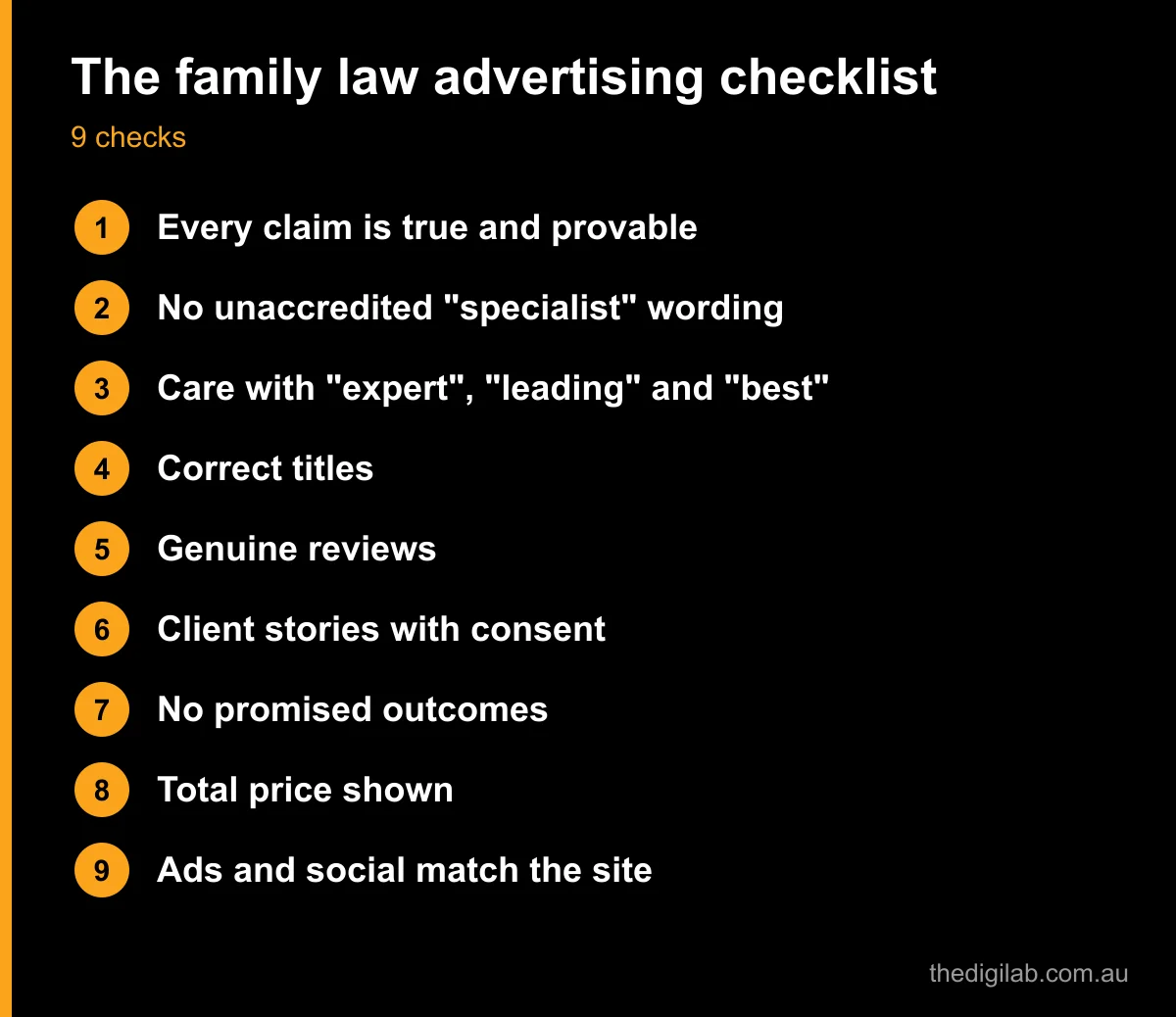
Run these nine checks across your website, Google Business Profile, ads and social media. Each one is explained in the sections below.
| # | Check | What compliant looks like |
|---|---|---|
| 1 | Every claim is true and provable | Years of experience, results, team size and awards match reality, and you can show evidence for each |
| 2 | No unaccredited "specialist" wording | "Specialist" or "Accredited Specialist (Family Law)" used only for QLS-accredited individuals, shown next to their name, not the firm's |
| 3 | Care with "expert", "leading" and "best" | No hyperbole; claims reflect the real ability and experience of the people named |
| 4 | Correct titles | "Partner", "principal" and "director" used only by people entitled to them |
| 5 | Genuine reviews | No fake or paid reviews; every client asked, not just happy ones; genuine negative reviews never removed |
| 6 | Client stories with consent | Written consent, comments de-identified, no detail that could identify the parties to proceedings |
| 7 | No promised outcomes | No "we'll get you the outcome you deserve"; past results never presented as a guide to future ones |
| 8 | Total price shown | Any quoted fee shows the total as a single figure, with what's included and excluded |
| 9 | Ads and social match the site | Google Ads, social posts and directory listings follow the same rules; no client photos or file commentary |
Which rules apply to family law firm advertising in Queensland?
Two sets of rules apply to family law firm advertising in Queensland: rule 36 of the Australian Solicitors' Conduct Rules and the Australian Consumer Law. The conduct rules have bound Queensland solicitors since 1 June 2012 (Queensland legislation), and the current 2023 version was updated in September 2026.
Rule 36 of the conduct rules
Rule 36.1 says a solicitor or principal must make sure any advertising, marketing or promotion is not "false; misleading or deceptive or likely to mislead or deceive; offensive; or prohibited by law" (QLS, Australian Solicitors' Conduct Rules 2023). A breach can amount to unsatisfactory professional conduct or professional misconduct.
Note who the rule names: the principal. If an agency writes your ads or website copy, the responsibility for what it says is still yours.
The Australian Consumer Law
The consumer law applies on top, and the Queensland Law Society notes it also applies as a law of Queensland (QLS). Three parts matter most for law firm marketing:
- Section 18 bans misleading or deceptive conduct in trade or commerce.
- Section 29 bans false or misleading representations, including false or misleading testimonials.
- Section 4 treats a claim about the future as misleading unless you had reasonable grounds for it. "We'll get you the outcome you deserve" is a claim about the future.
Can a lawyer call themselves a specialist or an expert?
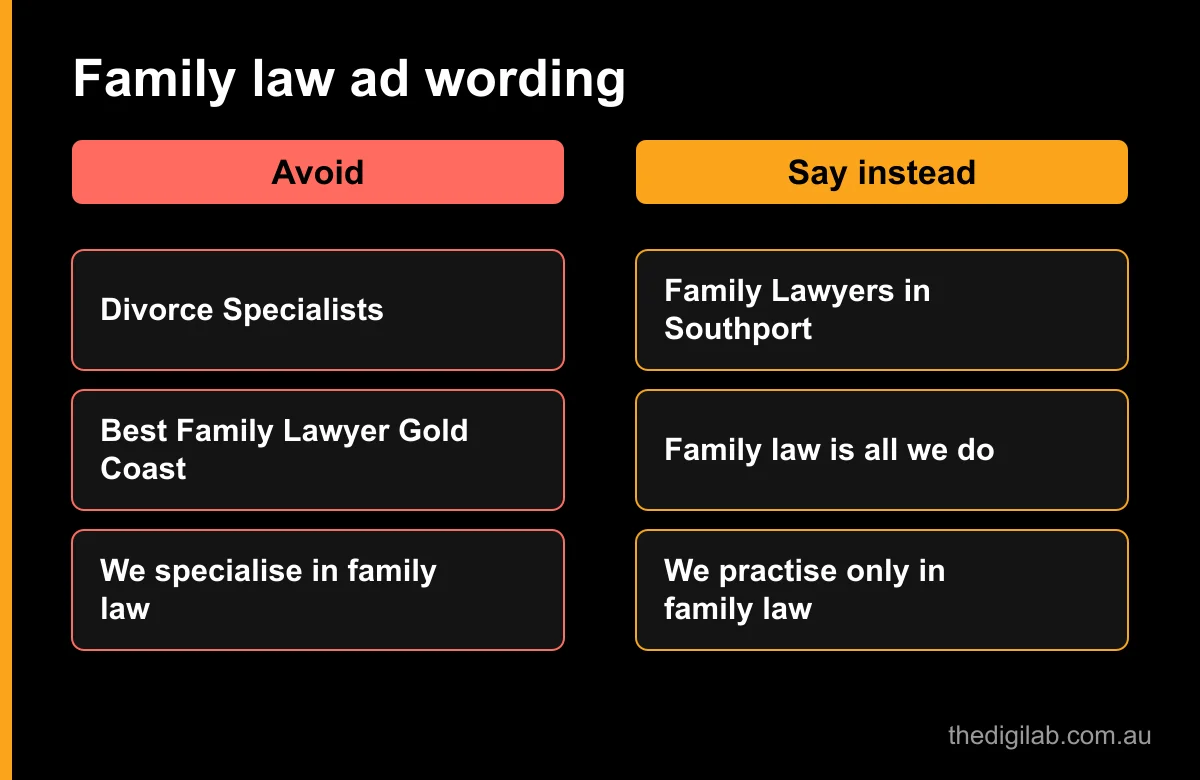
A Queensland lawyer should only call themselves a specialist if they hold QLS specialist accreditation. Rule 36.2 bars any false impression of specialist expertise and restricts the words "accredited specialist" and their derivatives. The Legal Services Commission's view is that "specialist" is likely one of those derivatives (QLS).
Few lawyers qualify. Just 487 Queensland solicitors, 3.5% of the profession, were accredited specialists in late 2023 (Proctor, 2023).
What accredited specialists can say
QLS offers specialist accreditation in family law, and its next intake, planned for 2027, is for family law only, depending on candidate numbers (QLS). Accreditation belongs to the person, not the firm. A firm can say its team includes an Accredited Specialist (Family Law), but the QLS marketing guidelines say the logo must sit next to the individual's name, never near the firm name (QLS Accredited Specialist guidelines, 2023).
"Specialise" versus "practise in"
QLS warns that a claim to specialise is likely to be read as a claim to expertise, not just a usual area of practice. So "we specialise in family law" carries the same risk as "family law specialist". "We practise only in family law" is fine if it's true.
"Expert", "leading" and "best"
QLS guidance says website statements "must avoid hyperbole and be an accurate reflection of the ability and experience of the people referenced" (QLS Guidance Statement No. 24, 2021). QLS's own pages differ slightly on "expert", so treat it with the same care as "specialist". "Leading" and "best" need evidence you could show a regulator.
Titles on your team page
The Legal Services Commission says "partner", "principal" and "director" are to be used only by those entitled to them (LSC, 2026). Check every team profile and LinkedIn headline.
Can law firms use reviews, testimonials and case results?
Queensland law firms can use reviews, testimonials and case results, as long as they're genuine, consented to and not misleading. Regulators do check. When the ACCC examined 137 businesses' online reviews, 37% had engaged in concerning conduct (ACCC, 2023).
Google reviews
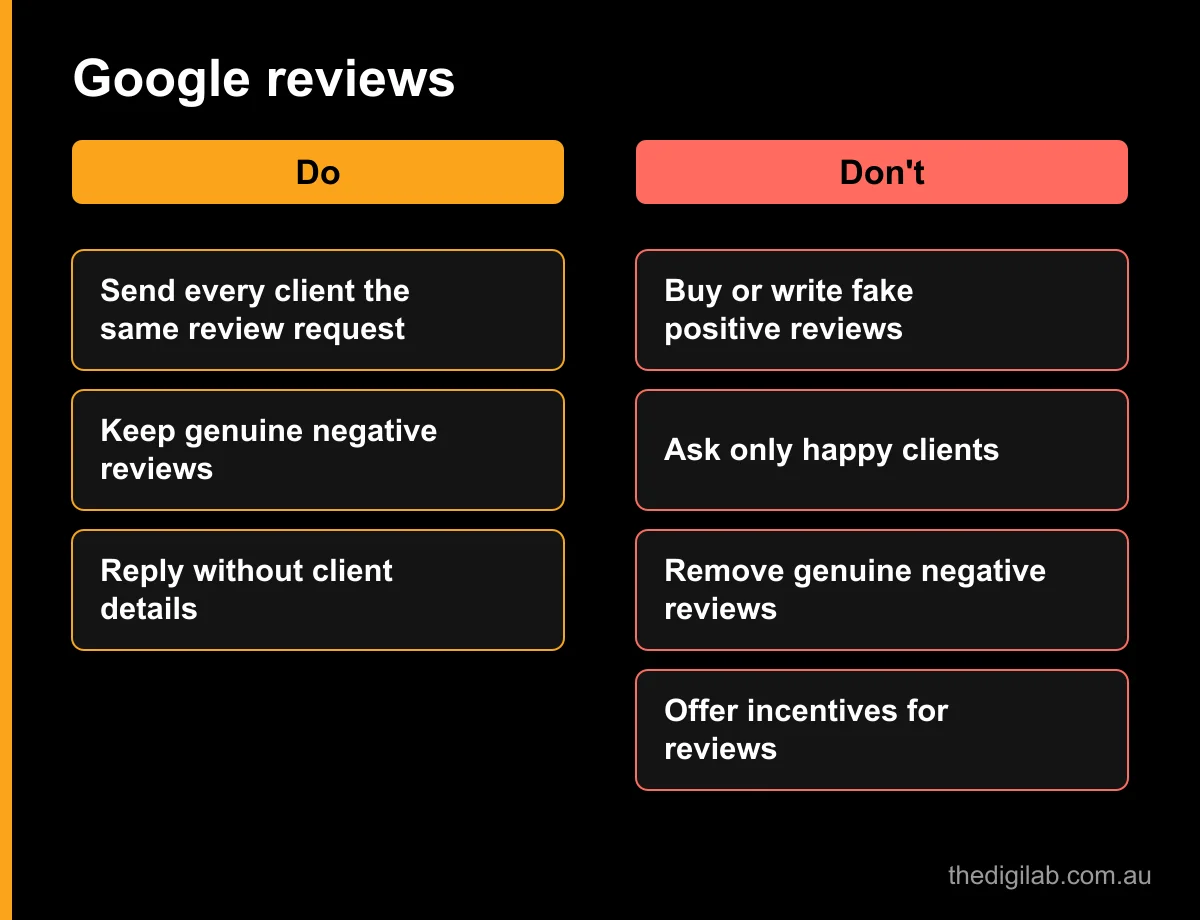
QLS says buying or writing fake positive reviews "would contravene a solicitor's fundamental duty of honesty". It also warns that asking only clients you know are happy "may be problematic" (QLS). The ACCC adds that removing genuine negative reviews can mislead, and any incentive must apply whether the review is good or bad (ACCC).
The simple fix: send every client the same review request when their matter closes. When you reply to a bad review, remember confidentiality still applies. You can't use client information to rebut it.
Testimonials
QLS guidance says to get the client's written consent first and de-identify their comments. Take a testimonial down if that client later falls out with the firm. Never post client photos without express consent, and don't allow unmoderated client comments on your pages (QLS Guidance Statement No. 24, 2021).
Client stories and case results
Family law needs extra care here. Federal family law restricts publishing anything that identifies the parties to proceedings, so a client story must stay unidentifiable even with consent. No QLS or Commission guidance deals with past results directly, so the general rules apply: a result must be accurate, and it mustn't suggest the next client will get the same outcome.
What can your Google Ads, social posts and fee claims say?
Google Ads, social posts and fee claims follow the same rules as your website, and nobody checks them for you. Google's policy says advertisers must "comply with the local laws and regulations of any area your ads target" (Google Ads policy). A September 2026 update repeats that advertisers must research local rules themselves (Google, 2026).
Google Ads
Ad headlines are short, which tempts firms into shortcuts like "Best Family Lawyer Gold Coast" or "Divorce Specialists". Both raise the problems covered above. Write what you can prove: "Family Lawyers in Southport" or "Fixed-Fee Consent Orders from $X" if the fee is real. Sitelinks, callouts and the landing page all count as advertising too. For help setting up campaigns that bring in enquiries, see our Google Ads management page.
Social media
QLS guidance says not to post running commentary on active files, and never to post client photos without express consent (QLS Guidance Statement No. 24, 2021). On LinkedIn, accepting an endorsement for a skill you don't have may breach rule 36.1 (QLS).
Fee claims
If you advertise a price, the ACCC says businesses "must display the total price of a product or service as a single figure", at least as prominent as any part price (ACCC). So "$990 + GST" on its own isn't enough. Show the total, and say clearly what's excluded, such as court filing fees. A "free first consultation" has to be exactly that. Your costs disclosure obligations still apply once a matter starts.
What happens if your marketing breaks the rules?
A breach of the conduct rules can amount to unsatisfactory professional conduct or professional misconduct, and disciplinary decisions are published under the lawyer's name. For the Victorian practitioner in our introduction, that meant a reprimand, a fine and extra ethics training.
Misleading claims can also breach the consumer law, where the stakes rose this year. For conduct on or after 28 March 2026, the maximum penalty for a company is the greater of $100 million, three times the benefit gained, or 30% of adjusted turnover. For individuals it's $2.5 million (ACCC).
Family law already draws close scrutiny. In 2024-25 the Legal Services Commission investigated 26 family law complaints, more than for deceased estates (24) or conveyancing (21) (LSC Annual Report 2024-25). Don't give a client one more reason to complain.
Frequently asked questions
Yes. Queensland's 16,188 practising solicitors can advertise, but under rule 36 of the Australian Solicitors' Conduct Rules their advertising must not be false, misleading or deceptive, offensive or prohibited by law. The Australian Consumer Law applies on top, including its rules on testimonials and claims about future outcomes.
Only if you're a QLS-accredited specialist in family law. The Legal Services Commission's view is that "specialist" is likely a derivative of "accredited specialist", which rule 36.2 restricts. Just 487 Queensland solicitors, 3.5% of the profession, held accreditation in late 2023. "We practise only in family law" is fine if true.
Only with care. The ACCC says any incentive must apply whether the review is positive or negative, and must be disclosed. QLS warns that asking only happy clients may be problematic. In one ACCC sweep, 37% of 137 businesses reviewed showed concerning review conduct. Asking every client, with no incentive, is safest.
Yes, if the fee is real and shown as a total. The ACCC requires the total price as a single figure, at least as prominent as any part price, so list what's excluded, such as court filing fees. Clear fees help clients too: only 56% of legal service users recall being told what their matter would likely cost (X-LULU Survey, 2026).
Disciplinary outcomes include reprimands, fines and costs orders, published under the lawyer's name. Under the Australian Consumer Law, the maximum penalty for false or misleading representations is now the greater of $100 million, three times the benefit or 30% of turnover for companies, and $2.5 million for individuals, for conduct from 28 March 2026.
Compliant marketing can still win clients
The rules don't stop you marketing well. They stop you overclaiming. In a 2026 survey of legal service users outside Victoria, skills and experience were the most common reason people gave for choosing a provider, at 51% (X-LULU Survey, 2026). Real lawyer profiles, honest fees and genuine reviews show exactly that. Start with the checklist at the top of this page: fix any "specialist" wording and your review requests first, then work through your ads and social profiles.
If your website needs work too, our family law website checklist covers the nine fixes that turn visits into enquiries. To see how we handle SEO and Google Ads for firms like yours, visit our family law marketing page.
Want a second pair of eyes? We'll check your website, Google Business Profile and ads against this checklist and send you a prioritised list of fixes. Book a free marketing review.