

Australia granted 49,158 divorces in 2025, up 4.1% on the year before (ABS, 2026). Many of those separations start with a search. Almost half of Australians who used a legal service (47%) said internet or social media searches shaped their choice (X-LULU Survey, 2026).
So for a lot of separating people, your website is the first member of your team they meet. Is it ready for them? A site can look polished and still lose enquiries. The usual faults are small: a phone number you can't tap, a long form, no hint of cost, and nothing for someone who needs to leave the page quickly.
This guide covers nine things a family law website needs before more Google Ads spend or SEO can pay off. The checklist comes first, so you can run it against your own site today.
Key takeaways
- Fix four breaks first. Most family law websites lose enquiries because the first screen is unclear, contact is hard or feels unsafe, nothing builds trust, or replies are slow.
- Make calling easy. Australians used the phone in 66% of legal matters (X-LULU Survey, 2026). Put a tap-to-call number on every page and keep the enquiry form to five fields or fewer.
- Build for safety. 17% of Australian women have experienced violence from a cohabiting partner (ABS, 2021-22). A quick exit button and a "safe to contact?" field protect those visitors.
- Explain how you charge. Only 56% of Australian legal service users recall being told what their matter would likely cost (X-LULU Survey, 2026).
- Load in under 2.5 seconds on a phone. Lead-generation pages that load in one second convert at almost 40%, against 34% at two seconds (Portent, 2022).
- Stay inside rule 36 and the Australian Consumer Law. No "specialist" claims without accreditation, no promised outcomes, and genuine reviews only.
- Track every enquiry. Record every call and form submission as a conversion. When we reviewed MCG Legal's tracking, the site logged page views but not enquiries, so its ads couldn't optimise for new clients.
The family law website checklist: 9 fixes before you spend more
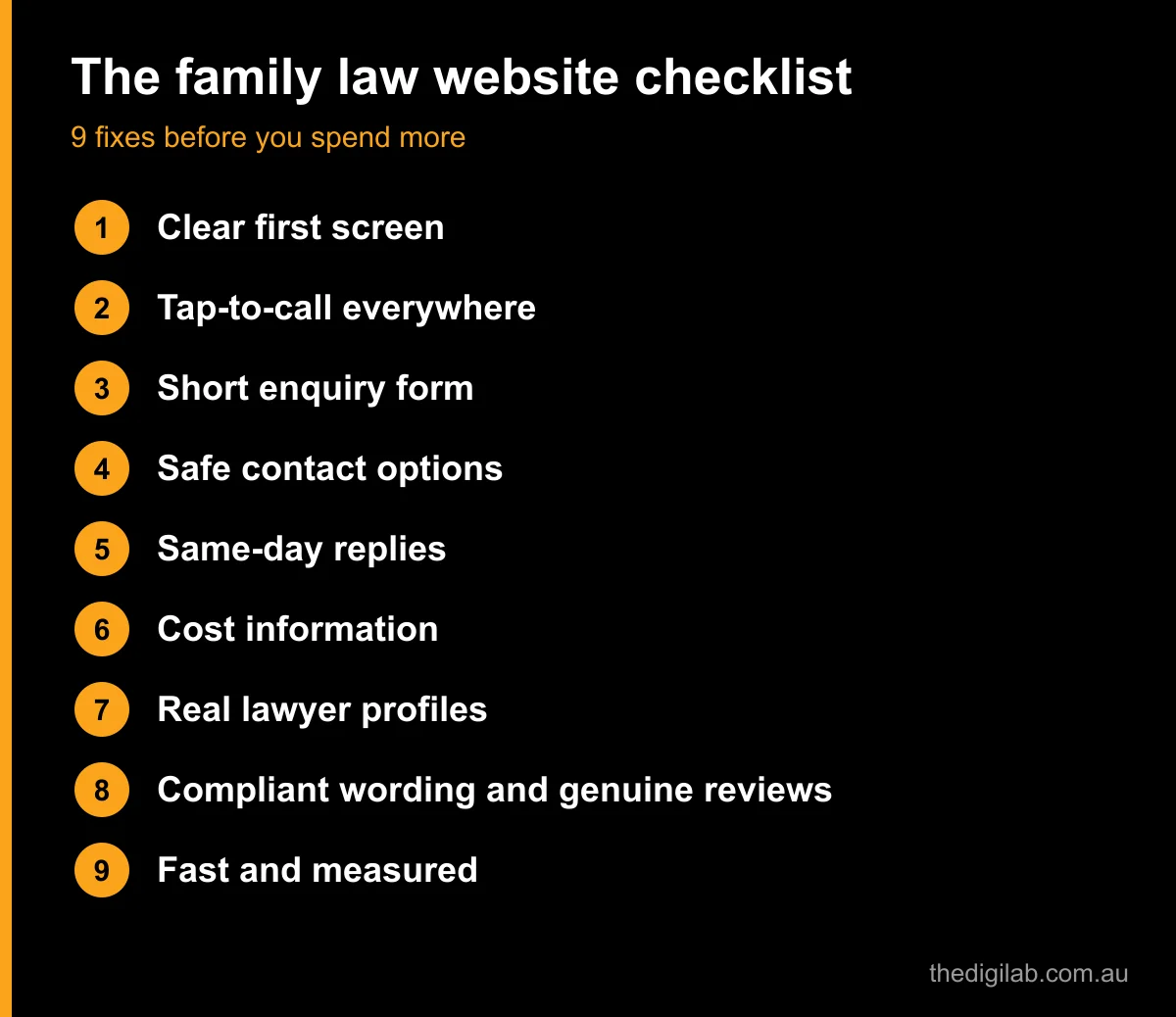
Short on time? Here are the nine fixes in one table, and the sections below explain each one. Demand isn't the problem: family law applications to the Federal Circuit and Family Court of Australia rose 3% to 101,092 in 2024-25 (QLS Proctor, 2025).
| # | Check | What good looks like |
|---|---|---|
| 1 | Clear first screen | Matter type, location and a phone number visible without scrolling on a phone |
| 2 | Tap-to-call everywhere | Number in the header of every page, plus a call button that stays on screen on mobile |
| 3 | Short enquiry form | Five fields or fewer: name, phone or email, matter type, safe contact time |
| 4 | Safe contact options | Quick exit button, a "safe to contact?" field, discreet confirmations |
| 5 | Same-day replies | Automatic confirmation, then a reply from a person the same business day |
| 6 | Cost information | How fees work, the first consultation fee, any fixed-fee options |
| 7 | Real lawyer profiles | Photo, year admitted, matter types; accreditation only if held |
| 8 | Compliant wording and genuine reviews | No "specialist" claims without accreditation, no promised outcomes, reviews shown as they are |
| 9 | Fast and measured | Largest Contentful Paint under 2.5 seconds on mobile; every call and form tracked to its source |
Why do family law websites lose enquiries?
Family law websites usually lose enquiries at one of four points between the search and the first conversation, and the fix is rarely a redesign. Slow follow-up alone costs work: in a secret-shopper test of 500 US law firms, only 40% answered the phone and 33% replied to an email (Clio Legal Trends Report 2024, via 2Civility).
These are the four breaks to look for:
- The visitor can't tell if you're right for them. The first screen talks about the firm, not their problem or their suburb.
- Contact is hard, or feels unsafe. The number isn't tappable, the form is long, or nothing suggests the enquiry will stay private.
- There's no reason to trust you yet. No faces, no idea of cost, no proof that real clients came away satisfied.
- The reply is slow. The enquiry lands, then waits until someone checks the inbox.
The rest of this guide fixes those four breaks in order.
What should a visitor see in the first five seconds?
In the first five seconds, a family law website should answer three questions without any scrolling: what you do, where you do it, and how to reach you. Plan for a small screen. Mobile made up 48.56% of Australian web traffic in October 2026, just ahead of desktop at 48.49% (StatCounter, 2026).
- Mobile48.56%
- Desktop48.49%
- Tablet2.95%
Source: StatCounter, October 2026
Here's what that first screen needs:
- A headline that names the problem and the place. "Family lawyers for separating parents in Brisbane's south" beats "Excellence in legal services".
- A tappable phone number and one main button. One clear action, such as "Book a first consultation", not four competing ones.
- What happens next. How long the first consultation runs, whether it's in person or by video, and what it costs. Only state what's true for your firm.
- Links to your main matter types. Divorce, parenting arrangements, property settlement and de facto separations each deserve their own page.
Keep the page focused. Unbounce's benchmark data recommends about 600 words for legal landing pages, and reports a median conversion rate of 6.3% for family law pages (Unbounce). Long walls of text about the firm's history push the contact options out of sight.
If you'd like to see how this looks in practice, our family law marketing page walks through the page structure we recommend.
How do you make contact feel safe and easy?
A family law website makes contact safe and easy with four things: a tap-to-call number on every page, a short form, a private way to say when it's safe to call, and a same-day reply. Start with the phone. Australians used it in 66% of legal matters, more than any other channel (X-LULU Survey, 2026).
Make the phone number work
Put a tap-to-call number in the header of every page, plus a call button that stays on screen on mobile. Show your hours beside it. Use a tracked number, so you know which pages and ads bring in calls.
Keep the form short
Ask only for what you need to call back: name, phone or email, matter type and a safe time to contact. Every extra field is another reason to stop. Even online shops ask for 11.3 fields on average when 8 would do (Baymard, 2024).
Offer safe contact options
This is the part most family law sites miss. In Australia, 17% of women (1.7 million) and 5.5% of men have experienced violence from a cohabiting partner since age 15 (ABS Personal Safety Survey, 2021-22). Some of your visitors are reading your site on a device someone else checks.
Simple changes help:
- A quick exit button that swaps the page for a neutral site in one tap. 1800RESPECT uses one, and notes it doesn't delete browser history, so link to its online safety tips too.
- A "safe to contact?" field on the form: best number, best time, and whether you can leave a message.
- Discreet confirmations. Keep matter details out of email subject lines and SMS previews.
Answer the same day
Speed matters after the click too. Set a same-business-day reply standard for every web enquiry, and send an automatic confirmation that says when you'll respond. In the Australian survey, failing to keep clients informed came up in 31% of cases where clients were dissatisfied (X-LULU Survey, 2026).
What builds trust on a family law website?
Four things build trust on a family law website: clear cost information, real lawyer profiles, genuine reviews and plain-English guides. Cost is the biggest gap. Only 56% of Australian legal service users recall being told what their matter was likely to cost, and 16% of those who paid faced higher costs than expected (X-LULU Survey, 2026).
Explain how you charge
You don't need a price list. You do need to explain how fees work. Say whether you offer fixed fees for some matters, what the first consultation costs, and what drives the cost of a property settlement or parenting matter. Your formal costs disclosure obligations still apply once a matter starts.
Show the people
Separating clients are choosing a person, not a logo. Give each lawyer a profile with a real photo, the year they were admitted, the matter types they handle and how they work with clients. List an accreditation only if the lawyer holds it. More on that below.
Use genuine reviews
The Queensland Law Society says clients "should be encouraged" to leave feedback and reviews, but they must be genuine (QLS). It also warns that asking only happy clients for reviews may be problematic. Show your Google rating as it is, and link to the full profile.
Answer the real questions
Short, plain-English pages on what to do first after separating, how parenting arrangements work and what property settlement involves build trust before any call. Each one is also a page that can rank in search.
Is your family law website fast enough on a phone?

A family law website is fast enough when its main content loads in under 2.5 seconds on a phone, Google's threshold for a "good" Largest Contentful Paint (web.dev). Every second counts: lead-generation pages that load in one second convert at almost 40%, against 34% at two seconds (Portent, 2022). Your visitors are often upset and short on time.
Small gains count. In Google and Deloitte's "Milliseconds Make Millions" study, a 0.1-second improvement in mobile speed lifted the number of lead-generation visitors reaching the form page by 21.6% (web.dev, 2020).
What to check:
- Run your home page and main service page through PageSpeed Insights. Look at the mobile result, not the desktop one.
- Aim for a Largest Contentful Paint under 2.5 seconds, Google's threshold for a "good" score (web.dev).
- Compress images and cut extra scripts. Chat widgets, sliders and tracking tags you no longer use are common culprits.
If the site still can't get under 2.5 seconds after these fixes, it may be time for a faster website build.
Can you see where your enquiries come from?
You can't improve what you can't measure. When we reviewed the ad tracking for MCG Legal, a boutique Gold Coast firm practising family law, conveyancing and estate planning, the website was recording page views but not enquiries. The ad platforms couldn't tell which campaigns produced clients, so they couldn't optimise for them. Only the campaigns that captured each enquiry directly, through lead forms, gave a reliable cost per lead.
What does the law let a family law website say?
Under rule 36 of the Australian Solicitors Conduct Rules, a solicitor's advertising must not be false, misleading or deceptive, and must not give a false impression of specialist expertise. The Legal Services Commission's view is that calling yourself a "specialist" is likely restricted to accredited specialists (Queensland Law Society). The Australian Consumer Law applies on top, so every claim on the site has to stand up.
The ACCC is blunt about intent: "It makes no difference whether a business intends to mislead or not" (ACCC). For a family law website, that means:
- No "specialist" wording unless the lawyer holds Queensland Law Society accreditation in family law, and take the same care with "expert". "Family lawyer" or "practises exclusively in family law" is fine if it's true.
- No promised outcomes. Avoid phrases like "we'll get you the result you deserve" or "win your case".
- Genuine reviews only. Section 29(1)(e) of the Australian Consumer Law bans false or misleading testimonials. The ACCC also says businesses can't remove genuine negative reviews or offer incentives only for positive ones (ACCC).
- Accurate cost statements. If the page says "fixed-fee divorce from $X", the fee and what it covers must match what clients actually pay.
This section is general marketing information, not legal advice. Check your own site with your practice's compliance contact. For the full rules, see our family law advertising rules checklist.
Frequently asked questions
A good family law website shows what you do and where within seconds, makes calling easy on a phone, offers safe contact options, explains how fees work and loads in under 2.5 seconds. It matters because 47% of Australian legal service users say online searches shaped their choice of provider (X-LULU Survey, 2026).
Shorter than most firms think. Unbounce recommends about 600 words for legal landing pages and reports a median conversion rate of 6.3% for family law pages. Cover the matter type, location, first consultation details and contact options. Put deeper explanations on separate guide pages and link to them.
It should at least explain how fees work. Only 56% of Australian legal service users recall being told likely costs, and 16% of those who paid faced higher costs than expected (X-LULU Survey, 2026). State the first consultation fee and any fixed-fee options, and make sure every figure is accurate.
We recommend one. In Australia, 17% of women have experienced violence from a cohabiting partner since age 15 (ABS, 2021-22). A quick exit button swaps your page for a neutral one in a single tap. Pair it with a link to 1800RESPECT's online safety tips, as the button doesn't clear browser history.
Yes, if they're genuine. The Queensland Law Society encourages client feedback and reviews but says they must be real. The Australian Consumer Law bans misleading testimonials, and the ACCC says businesses can't remove genuine negative reviews. Display your rating as it stands and link to the full review profile.
Fix the website before you buy more traffic
Your website does the first interview for you. More ad spend on a site that doesn't convert just buys more lost enquiries. Start with the fixes that cost least: tap-to-call on every page, a shorter form and a quick exit button. Then work down the checklist at the top of this page.
Want a second opinion? We'll review your family law website against this checklist and send you a prioritised list of fixes. Book a free website review.